Thursday, May 3, 2012

Idea #6: Stemming the Invasion of Kipple

Description
I've been following through on the long-held idea to buy a car and move to another place, so I've been too busy to mull over hare-brained ideas. But while unpacking my stuff, I came up with one for getting rid of old stuff. I got rid of as much stuff as I could while packing, by put it out on the lawn with an ad on Craiglist saying "Curb Alert: Free shit!" (which is surprisingly effective - people [with horrible psychologically-based hoarding issues, no doubt] troll Craigslist for those kinds of ads), and dropping everything else off at Goodwill. But I still have all this stuff.

So I thought, "You know, if a fire rips through your home or a burgler puts his gun to your temple, there's really not much stuff you care to think about, other than your life." I wondered what I would choose to keep if someone put a gun to my head and said, "Is that really something you need?"

An extreme situation? Yes, definitely. But if this were some kind of new revival of the Saw films, and  Jigsaw were mind-fucking me to make me see some deeper meaning in life or something - what would I choose to get rid of in that dire situation?

The idea: each week, pick 10 things that are unnecessary to the continuation of my life and toss them in the trash. They could be big or small, like when playing strip poker and choosing to take off the watch or a sock so my shirt doesn't have to come off. But eventually, just like strip poker, I'd get down to the bare essentials. Every week, I'd get closer and closer to the smallest set of things I really needed.

Steps
1) Look around my room full of unpacked boxes.
2) Pick 10 items as I see them.
3) Throw them in the trash. No excuses.
4) Repeat the next week, moving to the various drawers of junk I have.

Enthusiam: Right now, with tons of stuff clogging up my smaller room with no basement to store junk in, it seems like a fantastic idea. I think my enthusiasm will wane as soon as I allow myself to make excuses for the things I keep.

Practicality: Seems incredibly practical, until some time in the future when I look around for something I decided to throw out during this life overhaul excercise. Whoops - there I go making excuses already.

Difficulty: Maybe humans are born hoarders - it's as difficult to let go of things as it is to accumulate them.

Monday, April 23, 2012

Idea: #5: Become a Bike Merchant

Description
I could fix up downtrodden bikes I find on the cheap and re-sell them on Craigslist for a small profit. I've been working on my own bikes for years, but it wasn't until I completely disassembled, painted, and reassembled a tandem bike I found abandoned by the metro. (For the record, it in terrible shape: completely rusted, and left unlocked several feet from the bike rack. Therefore, I maintain it was abandoned).  After obsessively working on it for two weeks straight, I have a glorious new bike, and ambitions to do the same with others.

Steps
1) Salvage bikes found on craigslist or elsewhere, where the owners are practically giving them away to get rid of them.
2) Fix them with new parts, maybe even paint.
3) Resell them on craigslist or elsewhere.

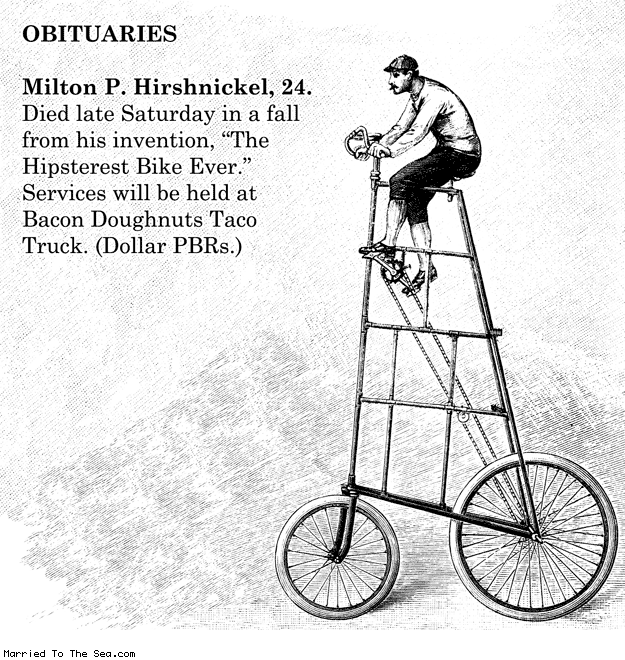
Originality: I would have said High a few years ago. Then bike-obsessed hipsters came along.

Enthusiam: I was on a high after finishing that monster of a project with the tandem bike. Now, it just seems like a lot of unnecessary work for only a little profit.

Practicality: Depends on the bike. I'm sure there are some hipsters out there who want old bikes, right?

Difficulty: Also depends on the bike. Now that I think about it, I've only fixed up three bikes in my life. There are professionals out there who do this all time, and with good bikes. 

Final Note: Know anyone in the market for a tandem bike?

Idea #4: Apprendre le Français en 15 Minutes Tous les Jours

Description
I studied German in high school, Russian in college and grad school, and Spanish off and on over the years with a few books here and a few classes there. What's one more language? Here's the idea for those who do not know enough French already to read the title of this post: learn French in 15 minutes a day.

Granted, I can't speak any of these languages fluently at the moment as I am out of practice (especially my German, which I've barely touched since senior year in '99). Not long ago I heard an interview on NPR with the author of Babel No More, Michael Erard, who talked about "hyperpolyglots" he wrote about - people who have learned dozens of languages. There was another author on the show who talked about people who picked up multiple musical instruments over their lifetimes - the similarity between musical instruments and languages being that there is an underlying structure to the sounds used. Erard talked about learners of multiple languages or instruments seeming to have "plasticity," or the flexibility and desire to focus on learning new things. I also remember hearing somewhere about a person who studied multiple languages at a time by only studying each language 15 minutes at a time, then moving on to something else for the rest of the day. It's sort of a tortoise vs. hare approach.

And some might think: It's not possible to learn a language without a teacher. Actually, many of the languages these polyglots picked up are self-taught. Now, the degree to which they actually could use the language may very, but a teacher is not required so long as their is practice and the ability to learn from mistakes. I learned that from reading the blog of Tim Ferriss, whose opinion is that classes are more like training wheels - the sooner they come off and you start practicing for reals, the better.

Diligently studying French in the Metro
So I thought, how about I just start learning French? I've always wanted to, so how about I start with a book on my 20 minute metro rides to work?


Steps
1) Purchase a decent book that teaches French.
2) Spend 15-30 minutes each day studying the underlying grammar, and most-needed vocabulary, listening to the CD that comes with the book for pronunciation.
3) Improve on the basic French ability: Read blogs or Twitter feeds from French speakers to get a beeter sense of common French usage. Watch TV shows and movies in French.
4) Practice: write sentences in French. Have short conversations with French speakers. 

Originality: Doesn't everyone say they want to learn a language? Buy a few tapes, go to some classes, and then before long it's dropped and the tapes and books collect dust on the shelf. In fact, I've got those for Mandarin Chinese and Philippines Tagalog on my shelf.

Enthusiam: So far I've kept it up for a couple months. But I've also been thinking of doing this for years - now is just when I seized the initiative.

Practicality:  The key here is that I also studied other languages. That means I have already learned three things that first-time language learners (or rather, first time second language learners) have to figure out:
1) How a language is structured; i.e. the basic grammatical concepts of any language;
2) How to go about learning a language: listening for proper pronunciation, common words to study, etc.; and
3) What works best for me: Flashcards, grammar books, writing practice sentences, and (when I can bring myself to) speaking with others.

Difficulty: Learning a lnaguage to any point of actual proficiency is hard - it takes a lot of time and practice. Sure I can learn French - the question is rather "how well?"

Sunday, April 15, 2012

Idea #3: Roomates: A Saga of Intrigue and Despair and Beer Cans and Dick Jokes

Standard sink condition
if it were set in the kitchen
Description
A play about living in a house full of roommates. The setting would be entirely within the living room, so it would be ideal for a play because scenery changes would be unnecessary. Set the stage so that the couches of the living room would face the audience, as though the people in the play were looking at the TV, and the audience would be looking at the actors as though through the television screen. The actors could enter and exit through the sides of the stages as though they were entering and exiting through the front door, bathroom door, bedroom door, kitchen door, etc. The play would focus on the various stories behind each roommate, some that would include the other roommates, while others would be secret from the roommates altogether.

Steps
1) Outline the story.
2) Learn how to write in the format of a play.
3) Dedicate time to writing and bang out the scenes.

Originality: This would be like the stage version of Australian author John Birmingham's non-fiction book of the best stories from his years living with dozens of roommates, He Died with a Felafal in His Hand, except set in one living room. Although it would be really tough to compete with Birmingham's stories.

Enthusiam: Medium. I've had this idea before. But I have yet to dedicate any time to thinking about the stories that would drive the play.

Practicality: Not very, considering I consistently dedicate my time to other pursuits. But something to keep in mind for the future.

Difficulty: Very. Have you ever tried to write a play? I really don't know how Shakespeare banged out so many in his lifetime.

Wednesday, April 11, 2012

Idea #2: Lottery Scratchers: An Investment Plan

Description
Buy lottery scratchers with the best odds of winning any prize, so that small winnings (from the amount of the ticket to $20 or so) will offset and maybe even outperform the cost of buying the scratchers. Perhaps some of the prizes will be on the medium side ($20-$200) and result in a modest return on the amount invested in buying losing or small prize-earning tickets. And then there's the hope of every sad sack buying a lottery ticket: hitting the grand prize! A man can dream, can't he?

Steps
1) Research the data available on the state lottery website to find the odds of winning any type of prize, the amount of tickets available, the amount of prizes unclaimed, and the odds of winning the top prize.

2) Pull the data into a spreadsheet and analyze it, picking out the ones with the best overall odds.

3) Go to the nearest convenience store and point at the ones I picked before hand, but try not too look to desperately hopeful when doing it.

4) Track the record of scratcher purchasing costs against the amounts won as a reality check: to keep from thinking that if I just buy a few more I can hit it big time.

Enthusiam: High, until I remember that I'm probably not the first person to think of this. Maybe they've just been really quiet about their strategy?

Practicality: Most people would probably say no, it's not practical, especially in the long run. I should probably set a loss limit of $50 or so, buying no more than $5-$10 scratchers at a time.

Difficulty: Pulling together the data is probably the most time consuming. Then there's the sweating bullets part as I hold up the line of people waiting to buy beer and junk food and endure the cashier's silent scorn so I can eye the tickets displayed under the counter.

Idea #1: Kickoff Idea: Start a Blog

This one's original. How many people these days decide to start a blog? Oh, I see. Google says there's . . . let's see . . . millions. Meh, I'm sure my idea for a blog is original.

While walking to work from the metro this morning, I was thinking about all the ideas that pass through my head everyday. People say I think a lot, but I don't quite understand how people can go through their day not thinking all the time. Anyways, the blog idea:

Description 
Create a blog to capture all those ideas I have, everything on a scale from practical to ridiculous, and entered in the order that I get them. Maybe that will get them to stop running through my head all day like little rabbits. And there's another idea: call it . . . Hare-Brain.

Steps
1) Create a blog on Blogger.
2) Start typing.

Easy enough.

Enthusiasm: High.

Practicality: I just created it, so I'm going to say, "High."

Difficulty: Let's just see how long I keep it up.